Does Path of Exile have an auction house? The answer has finally changed. PoE 1 got a currency-only exchange in patch 3.25, and Path of Exile 2 launched a full asynchronous trade system in patch 0.3.0 (The Third Edict). This guide covers everything — from how the old system worked to how to use the new one today.
| PoE 1 currency exchange patch | 3.25 |
| PoE 2 full async trade patch | 0.3.0 |
| Playtime spent trading (GGG data) | 30% |
| Third Edict launch date (2025) | Aug 29 |
Why Path of Exile resisted an auction house for so long
Since launch, Grinding Gear Games deliberately avoided a traditional auction house. Their philosophy: trading should be a social mechanic, not a vending machine. Creative Director Jonathan Rogers stated that negotiating trades directly builds community bonds — automating it would “sterilize the experience.” GGG also pointed to Diablo 3’s real-money auction house as a cautionary tale of how automated markets can hollow out an economy.
The result was a barter economy using orbs and scrolls as currency, with all trades completed manually between two online players. A large player-built ecosystem filled the gap — third-party indexers like poe.trade, then the official trade website — but the friction never went away. GGG’s own data eventually showed players spending roughly 30% of their playtime on trade logistics instead of actually playing.
- Key context: So, Path of Exile never had a gold-economy. Finally, currency items (Chaos Orbs, Exalted Orbs, Divine Orbs) will be both crafting materials and trade money. This dual role also complicates the balancing of automated trading a lot compared to games that have a single dedicated currency.
Path of Exile 1 — the currency exchange (patch 3.25)
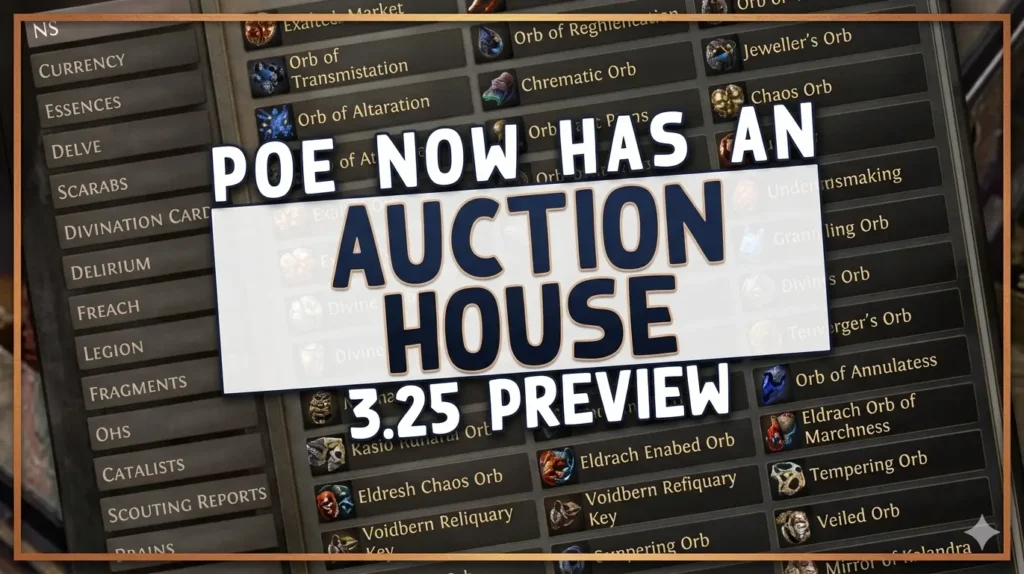
In the Settlers of Kalguur league (patch 3.25), GGG introduced the first official exchange feature to PoE 1: a currency-only auction house run by an NPC named Faustus the Financier. This was a deliberate, limited first step before the bigger changes arriving in PoE 2.
| Feature | Detail |
| What can be traded | Stackable currencies — orbs, essences, divination cards not gear |
| How buyers pay | Gold (an untradeable, account-bound currency farmed in-game) |
| Instant buyout | Yes — no need to message or meet the seller |
| Seller presence required | No — sales complete while you are offline |
| Anti-manipulation measure | Gold cost creates friction for bot farms and mass-relisting |
| What it does NOT cover | Weapons, armour, unique items, flasks — still peer-to-peer |
Price manipulation still exists: Wealthy players or groups can buy large quantities of a currency and relist at inflated prices, creating artificial scarcity. The gold cost raises the bar, but it does not eliminate this entirely.
Path of Exile 2 early access — the trade website era
When PoE 2 launched in December 2024 early access, there was no in-game auction house. The only official trading tool was the Path of Exile 2 trade website — a searchable database of public stash tabs. Around 90% of all trading activity ran through this external site.
What the trade website did well
| Granular mod filters (e.g. “+2 to socketed minion gems” |
| Live search for newly listed items |
| Direct whisper integration with in-game chat |
| Separate Standard and Hardcore listings |
Persistent problems
| Both players must be online simultaneously |
| Item swapping during the trade window |
| Price baiting with fake low listings |
| Offline sellers with active listings |
| 99% of trade attempts result in silence |
The in-game Currency Exchange (unlocked post-campaign via Alva) let players swap one currency type for another at market rates. This was closer to an order-book exchange than an auction house — supply and demand from all active orders determined rates in real time.
Path of Exile 2 patch 0.3.0 — the asynchronous trade system (The Third Edict)
Patch 0.3.0, released August 29, 2025, introduced Path of Exile 2’s biggest quality-of-life change: a fully asynchronous trade system. Sellers can now list items and log off. Buyers can purchase at any time without coordinating schedules. This is the closest thing PoE 2 has had to a true auction house.
New in 0.3.0: The system introduced a new NPC (Ange), Merchant’s Stash Tabs, an in-game Market Panel, and a gold fee on purchases. The old manual whisper system remains available in parallel.
Meet Ange — your personal trade broker
Ange is an NPC representing the Meridian Free Traders Company. She replaces Alva/Faustus as the gateway to the Currency Exchange and also serves as your personal merchant in your hideout. You first meet her in Kingsmarch (Act 4) and can invite her to your hideout once it is unlocked.
| Ange’s role | What she does |
| Personal merchant | Lists your items, manages your shop, stores earnings |
| Currency Exchange access | Replaces the old Alva/Faustus interface |
| Offline agent | Handles sales and collects payment even while you are logged off |
| Notification hub | Alerts you in-game when a sale completes |
Merchant’s Stash Tabs
Merchant Tabs are required to list gear via Ange. Stackable currency (orbs, fragments, essences) must go through the Currency Exchange, not Merchant Tabs. Tabs can be purchased in the microtransaction store, or if you owned Premium Stash Tabs before the 0.3.0 launch, you can convert them on the official website — this conversion is permanent and removes the tab from PoE 1 if you play both games.
How to sell items — step by step
- Progress to Act 4 and meet Ange in Kingsmarch. Complete the “Hostile Takeover” quest to unlock your hideout (defeat Diamora on Wakapanu Island if you don’t have one yet).
- Invite Ange to your hideout. She will appear automatically once your hideout is unlocked.
- Open Ange’s “Manage Shop” interface. Place the item into a Merchant Tab slot and set your price in Chaos Orbs, Exalted Orbs, or other standard currencies.
- Pay the small gold listing fee. The item is now live on the official trade site and the in-game Market Panel.
- You have approximately 30 seconds to change the price or remove the item freely. After that, a cooldown applies — this is intentional to prevent market manipulation.
- Log off and play normally. When the item sells, you receive an in-game notification and a visual indicator appears above Ange. Earnings are held in her Earnings Tab until you collect them.
Critical pricing advice: Because transactions are instantaneous, an underpriced item will sell the moment someone finds it. Always cross-check similar listings on the trade site before setting your price. Do not copy suspicious low-ball listings — those are often from price-fixers who never intend to actually sell.
How to buy items — step by step
- Open the in-game Market Panel (press “/” on PC) or visit the official Path of Exile 2 trade website. Both show the same listings.
- Filter by item type, mods, rarity, price range, and requirements. Use the “Instant Buyout Only” filter to see only asynchronous listings (no seller coordination needed).
- Find your item and click “Secure Item.” This teleports you instantly to the seller’s hideout — they do not need to be online.
- Interact with Ange in the seller’s hideout. Click purchase on your desired item. The listed price plus a small gold fee is deducted automatically.
- If another buyer reaches Ange first, you miss out — first to pay wins. Browse the seller’s other listings while you’re there.
Old vs new: full trading system comparison
| Feature | Old system (whisper/trade site) | New async system (patch 0.3+) |
| Seller must be online | Yes | No |
| Buyer must be online | Yes | No (sort of) |
| Transaction speed | Minutes to hours (waiting for replies) | Seconds (instant teleport + purchase) |
| Item swapping scams | Possible | Eliminated |
| Price baiting | Common | Reduced (still exists) |
| Offline listings | Active but unactionable | Fully purchasable |
| Gold fee on purchase | No | Yes (small sink) |
| Gear tradeable | Yes | Yes (via Merchant Tab) |
| Currency tradeable | Yes | Yes (via Currency Exchange) |
| In-game market browser | No | Yes (press /) |
| Price change cooldown | None | Yes — after ~30 second grace window |
| Tab required | Premium Stash Tab | Merchant’s Stash Tab |
Pro tips and warnings
Pricing safely
The biggest risk in the new system is undercutting yourself due to price fixers. These players list items at deliberately low prices they never intend to honor — to trick other sellers into lowering their own listings. Always verify prices using direct searches on the trade site before setting a final price in Ange’s shop. A useful rule: if you see a cluster of suspiciously cheap listings surrounded by much higher ones, the low listings are likely bait. Price at the second cluster.
Gold fee budgeting
Every purchase through Ange includes a gold fee on top of the item price. This accumulates noticeably if you trade frequently in a session. Farm gold by defeating monsters, completing quests, or selling vendor fodder before embarking on a buying spree.
Merchant Tab strategy
If you play both PoE 1 and PoE 2, do not convert all your Premium Tabs to Merchant Tabs at once. Converting is permanent and removes the tab from PoE 1. Start with two or three Merchant Tabs and keep the rest as Premium Tabs for PoE 1 trading or as dump tabs.
Future plans: GGG has confirmed that once the asynchronous system is refined in PoE 2, it will eventually be implemented in Path of Exile 1 as well. The currency exchange (Faustus system) from 3.25 was the first step in that direction.
Frequently asked questions
Does Path of Exile 1 have an auction house?
Not a full one. PoE 1 has a currency-only exchange (introduced in 3.25 via Faustus) that handles stackable items like orbs, essences, and divination cards. Gear still requires direct player-to-player trading through the trade website and whisper system.
Does Path of Exile 2 have an auction house?
Effectively yes, as of patch 0.3.0 (The Third Edict, August 2025). The asynchronous trade system lets you list items through the NPC Ange and have them sold automatically while offline. It functions like an auction house for fixed-price listings, not a bidding system.
What is the gold fee in the PoE 2 trade system?
Every purchase through Ange costs the listed price plus a small gold fee. Gold is untradeable and account-bound, so this fee acts as a deliberate economy sink to discourage high-volume item flipping and bot activity.
Can I still trade directly player-to-player in PoE 2?
Yes. The old manual system (whisper the seller, meet in hideout, use the trade window) remains fully available. Listings in Premium Stash Tabs (not Merchant Tabs) show a “Direct Whisper” button on the trade site instead of “Secure Item.”
Can I trade currency through Ange’s Merchant Tab?
No. Stackable currency items (orbs, shards, fragments, essences, gems) must go through the Currency Exchange. Merchant Tabs are only for gear, unique items, and non-stackable equipment.
Do I need a hideout to use the new trade system?
Yes. A personal hideout is required to host Ange. You unlock one in Act 4 by completing the “Hostile Takeover” quest — defeat the boss Diamora on Wakapanu Island, then speak to Ange in Kingsmarch.
What happens to my Premium Stash Tabs if I convert them to Merchant Tabs?
The conversion is permanent. The tab is removed from Path of Exile 1 and becomes a Merchant Tab in PoE 2. Only standard Premium Stash Tabs purchased before the 0.3.0 launch are eligible. Quad Tabs and specialty tabs cannot be converted.
How do I open the in-game market browser in PoE 2?
Press the Slash key (/) on PC. The market panel opens and lets you search, filter, and purchase items directly without leaving the game or visiting the trade website.
Will PoE 1 ever get the full asynchronous system?
GGG has confirmed that yes, once the system is tested and refined in PoE 2, it is intended to come to Path of Exile 1. No release date has been given.