

Introduction to the Path of Exile Passive Skill Tree
From the path of exile passive skill tree, to one of the most ambitious character-progression systems ever seen in an action RPG. The game has well-known mechanics which are based on a vast web of interconnected nodes connected between 1,500 things and serves to define who you are (build-wise) as your character, where your power budget lies and the way that you play right from the moment that you take in your first breath in Wraeclast.
Instead of the typical class-and-skill-tree separation found in most ARPGs, Path of Exile presents every class with a single, unified tree. Your choice of starting class is just where you start on that tree, so theoretically, any class can reach any passive node. The tree favors planning and specialization and a strong knowledge of its geography.
This guide contains everything: tree structure, every node type, starting positions per class, the best keystones for maximum power over time for each class archetype in the 2025 season, and expert advice on putting points in absolutely every corner of this sprawling tree!
How the Passive Skill Tree Is Structured
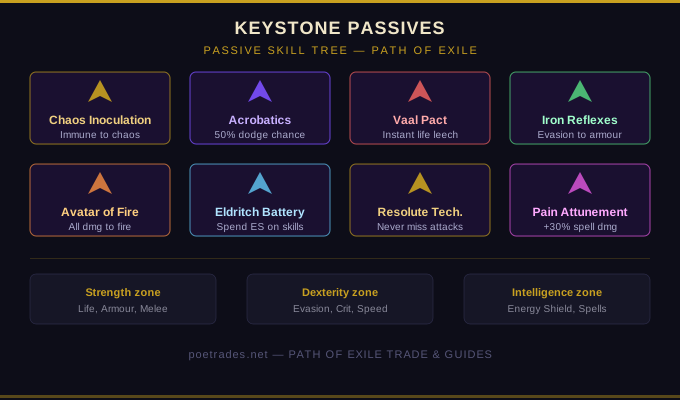
The Passive Skill Tree has three general regions each dominated by one of its three core attributes: Strength, Dexterity, and Intelligence. These regions are not walls (they fade into one another in hybrid zones), but they exert a strong control over what kinds of nodes exist where.
The Three Attribute Domains
| Domain | Attribute Focus | Starting Classes | Typical Playstyle |
| Strength (Top) | Life, Armour, Melee Damage | Marauder, Templar (partial) | Tanky melee, slam builds |
| Dexterity (Bottom-Right) | Evasion, Attack Speed, Crit | Ranger, Duelist (partial) | Bow builds, DoT, fast attackers |
| Intelligence (Top-Right) | Energy Shield, Mana, Spell Power | Witch, Shadow (partial) | Spellcasters, summoners, ES builds |
| Hybrid Zones (Center) | Mixed attributes | Scion | Versatile multi-class hybrids |
Keystones — Game-Changing Passive Nodes
Keystones are the most powerful and transformative nodes on the tree. Each one fundamentally alters a core game mechanic — always with a significant tradeoff. Reaching a keystone often requires routing a long path of passive points, but the payoff can define an entire build archetype.
| Keystone | Benefit | Drawback | Common Builds |
| Acrobatics | 50% Dodge Chance vs Attacks | -50% Armour / ES / Block | Evasion rangers, dodge builds |
| Chaos Inoculation | Immune to Chaos Damage | Maximum Life becomes 1 | Full ES characters |
| Eldritch Battery | Spend Energy Shield on Skills | ES no longer recharges | High-DPS spellcasters |
| Iron Reflexes | Convert all Evasion to Armour | Lose all Evasion rating | Armour-stacking hybrids |
| Resolute Technique | Never miss (100% hit chance) | Cannot deal Critical Strikes | Reliable non-crit melee |
| Avatar of Fire | 100% of damage converted to Fire | Can only deal Fire damage | Ignite prolif, fire DoT |
| Pain Attunement | +30% Spell Damage at low life | Requires staying at low life | CI/LL spellcasters |
| Vaal Pact | Life leech is instant | Life regeneration disabled | Leech-sustain melee builds |
Node Types Explained
The Passive Skill Tree contains several distinct node types, each with a different role in your build. Understanding each type is essential for efficient point allocation.
Small Nodes
The most common node type. Small nodes provide modest stat increases such as +10 Strength, +5% increased Life, or +8% increased Attack Speed. They primarily serve as connectors between larger nodes and should only be taken when the path is unavoidable or when the minor stat is genuinely needed.
Notable Passives
Notable passives are larger nodes marked with a distinctive visual indicator. They offer meaningful bonuses — typically 2 to 4 combined stats — and represent genuine decision points in your pathing. Plan your route to collect the Notables relevant to your build while minimizing filler small nodes.
Keystones
Described in detail in the table above. Keystones are single, powerful nodes that completely transform a game mechanic. Every build must decide early whether it requires a keystone and plan the tree path accordingly.
Mastery Nodes
Introduced in Path of Exile: Siege of the Atlas expansion. Each cluster of themed passives contains a central Mastery node. Once you have at least one Notable in that cluster, you can spend 1 passive point to unlock a bonus selected from a themed menu list. Mastery nodes offer exceptional point-for-point value.
Jewel Sockets
Jewel sockets are nodes that don’t provide stat bonuses themselves but accept Jewel items. A well-rolled Rare Jewel can provide more value than 6-8 small nodes combined. Prioritize jewel sockets situated near high-value Notables and Keystones.
Cluster Jewels
Large, Medium, and Small Cluster Jewels can be placed in the outer jewel sockets to expand the tree with entirely new sub-clusters. Large Cluster Jewels contain 8-12 nodes including their own Notables — and occasionally Keystones. They are among the most efficient ways to scale a build in the endgame.
Starting Positions by Class
Each of Path of Exile’s seven base classes begins in a different location on the Passive Skill Tree. While any class can theoretically reach any node, starting position heavily influences early pathing efficiency. Choosing the right class for your intended build saves 4-8 passive points versus cross-tree routing.
| Class | Ascendancies | Primary Attribute | Starting Area Speciality | Difficulty |
| Marauder | Juggernaut, Berserker, Chieftain | Strength | Life, Armour, Melee | Beginner |
| Ranger | Deadeye, Raider, Pathfinder | Dexterity | Attack Speed, Evasion, Bows | Intermediate |
| Witch | Necromancer, Elementalist, Occultist | Intelligence | Energy Shield, Spells, Minions | Intermediate |
| Duelist | Slayer, Gladiator, Champion | Str / Dex | Melee DPS, Bleeding, Block | Intermediate |
| Templar | Inquisitor, Hierophant, Guardian | Str / Int | Holy damage, Totems, Auras | Intermediate |
| Shadow | Assassin, Saboteur, Trickster | Dex / Int | Critical Strike, Traps, ES+Eva | Advanced |
| Scion | Ascendant (multi-ascendancy) | All (center) | Universal flexibility | Advanced |
Top Build Archetypes for the Passive Skill Tree (2025)
The following build archetypes represent the most efficient and widely-played passive tree configurations in the current meta. Each one prioritizes different regions of the tree and different keystone interactions.
1. Righteous Fire Juggernaut
One of the most durable league starters in Path of Exile history. This build rushes Marauder life nodes, picks up the Juggernaut Ascendancy for permanent stun immunity and endurance charge generation, then paths toward the Templar zone for totem-based regeneration. Primary goals on the tree: maximum Life pool, high Fire Resistance, and the Avatar of Fire keystone.
| Tree Priority | Target Nodes | Approximate Points |
| Phase 1: Early Life | Marauder life cluster, Warrior’s Blood | 1-30 |
| Phase 2: Defence | Endurance Charges, Armour scaling | 31-60 |
| Phase 3: Damage | Burning damage, Fire DoT multi, Avatar of Fire | 61-90 |
| Phase 4: Optimization | Mastery nodes, Cluster Jewels, jewel sockets | 91-123 |
2. Deadeye Tornado Shot Bow
The archetypal glass-cannon bow build. Starting in the Ranger zone, it aggressively maximizes Attack Speed, Critical Strike Multiplier, and Projectile passives. The build leverages Large Cluster Jewels for extreme DPS scaling and relies on the Deadeye Ascendancy’s additional projectiles and tailwind for both offense and mobility.
3. Necromancer Summoner (Witch)
Among the most beginner-friendly builds in PoE. The passive tree path prioritizes Minion Damage, Minion Life, and Energy Shield nodes throughout the Witch and Shadow zones. The build peaks with Necromancer Ascendancy, then invests in Duration and Reservation efficiency for aura stacking.
4. Chaos Inoculation Occultist
An endgame specialist build targeting the Chaos Inoculation keystone. With Max Life reduced to 1, the entire defensive layer shifts to a massive Energy Shield pool drawn from Intelligence nodes, cluster jewels, and ES-scaling gear. Among the highest-ceiling builds in Path of Exile with sufficient investment.
Expert Tips for Navigating the Passive Skill Tree
Tip 1 — Plan Before You Spend
Use Path of Building (PoB), the community-standard offline planning tool, to map your entire passive tree before spending a single point in-game. Respeccing via Orbs of Regret is expensive at scale. A 20-node mistake can cost significant currency to fix.
Tip 2 — Identify Your Keystone Early
If your build requires a Keystone, calculate the cheapest starting class path to reach it before choosing your class. Sometimes switching starting class saves 4-6 passive points compared to a long cross-tree route.
Tip 3 — Jewel Sockets Are High-Efficiency Nodes
A single jewel socket costs 1 point and provides nothing alone — but a well-rolled Rare Jewel outperforms 6-8 minor small nodes. Place priority on sockets near high-value Notable clusters.
Tip 4 — Cluster Jewels Compress Passive Points
The right Large Cluster Jewel combination can deliver the equivalent of 15+ standard tree points in just 3-4 efficiently routed passive investments. Research current league meta cluster options on poetrades.net before crafting or purchasing.
Tip 5 — Never Over-Invest in Off-Path Nodes
New players often spread points too broadly, trying to collect every appealing Notable. Every off-path point spent is damage, defense, or utility your build never gets. Focus on your build’s primary axis and be ruthless about cutting anything that does not serve it directly.
Tip 6 — Use Mastery Nodes for Free Specialist Power
Mastery nodes cost 1 point each and unlock from a themed menu once you have a Notable in the same cluster. They are among the best point-for-point efficiency nodes in the game. Always check the mastery menu for your build’s relevant clusters before finalizing your tree.
Quick Reference: Passive Skill Tree Summary
| Element | Details |
| Total Passive Points Available | 123 base (99 from leveling + 24 from quests) + 8 Ascendancy points |
| Total Nodes on Tree | 1,500+ nodes across the full tree |
| Number of Keystones | Over 20 keystones spread across all regions |
| Classes | 7 base classes, each with 3 Ascendancy sub-classes |
| Cluster Jewel Types | Large (8-12 nodes), Medium (4-6), Small (2-4) |
| Respec Method | Orbs of Regret (1 per point) + quest rewards |
| Best Planning Tool | Path of Building (offline) + poetrades.net (trade) |
Frequently Asked Questions
How many passive skill points can I earn in Path of Exile?
You gain 99 base passive points by leveling from level two to 100, and earn an additional 24 through quests – for a grand total of a 123. Qualified characters (those who complete the game and all 4 main Quest Labs) receive up to 131 usable Points, of which the last 8 are Ascendancy-specific points from Ascendancy Labyrinth trials (2 per lab).
Can I respec my passive skill points?
Yes. Each Orb of Regret allows you to refund one passive point. A few free Regret points are available from quests. Full respeccing of an entire tree is possible but expensive — always plan builds carefully before committing.
What are the best tools for planning a passive skill tree build?
Path of Building (PoB) is the gold-standard offline planner used by the entire community. For live trade, currency, and gear planning to match your tree, visit poetrades.net.

From filling notebooks with stories as a young girl to creating lines of folders filled with files now, writing has always been my passion. While it was a video game that inspired me to craft my own stories, develop characters, settings, interactive mechanics, and even a magic system when I was young, it wasn’t until 2020 that I accepted what I had been doing for years was professionally called game writing.