
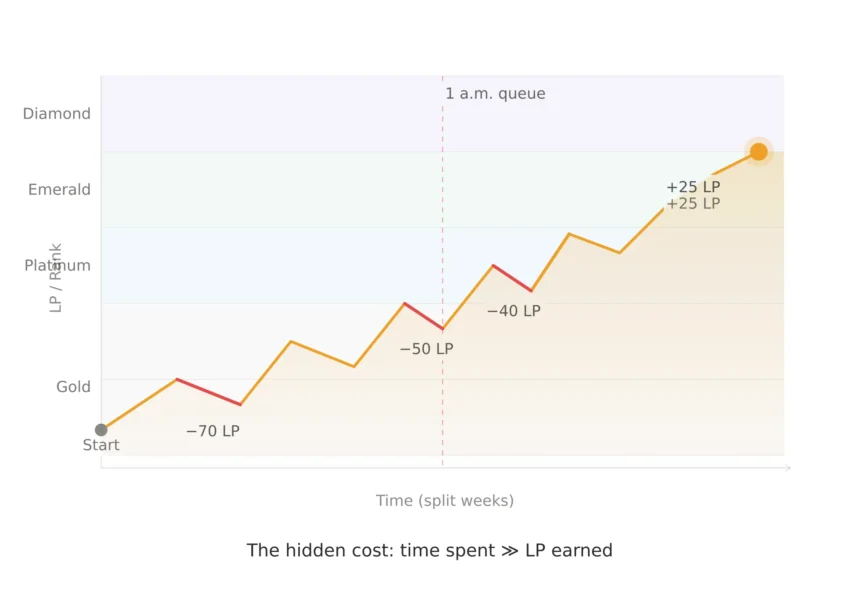
Most League of Legends players obsess over LP. A win feels great when you see that +25 pop up on the screen, while a loss feels even worse when it completely wipes out the progress from your previous two games. The funny thing is that LP is rarely the most valuable thing you’re spending on ranked. Most players eventually realize that time is the resource they’re actually running out of.
Think about a typical split. You start in Platinum, set a goal of reaching Emerald, and tell yourself you’ll play a few games every evening. A month later, you’re still hovering around the exact same rank. Some nights you gain 60 LP. Other nights you lose it all because of a bad streak, an autofilled jungler who has no idea how to path, or simply because you kept queueing after midnight when you should have gone to bed. This is where many players start to realize that climbing is not only about skill. It is also about available time.
Ranked Rewards Consistency, Not Brilliance
League players love highlight moments. Everyone remembers the late game pentakill, the blind Baron steal, or the match where they went 12/2 and completely took over the map. Unfortunately, the ranked ladder does not care much about your best performances. A player who performs at an 8 out of 10 level every game will usually climb faster than someone who carries one match, ints the next, and spends the third game arguing in chat. The ladder rewards repeatable performance far more than occasional brilliance.
Maintaining that level of consistency is much harder than most guides make it sound. After work, school, or university, most people queue up because they want to relax, not because they are about to deliver their best League of Legends performance of the week. Then one bad loss turns into two. Suddenly it is 1 a.m., you have dropped 70 LP, your reaction times are gone, and you are still convincing yourself that the next game will turn everything around. Most long time League players have experienced that exact scenario.
Why Duo Boosting Became Popular
A few years ago, boosting usually meant giving someone your account details, stepping away from your PC, and hoping everything went smoothly. Many players are no longer comfortable with that idea because of security concerns and improved account detection systems. Instead, duo boosting has become increasingly popular because it allows players to stay on their own accounts while playing alongside a higher ranked partner.
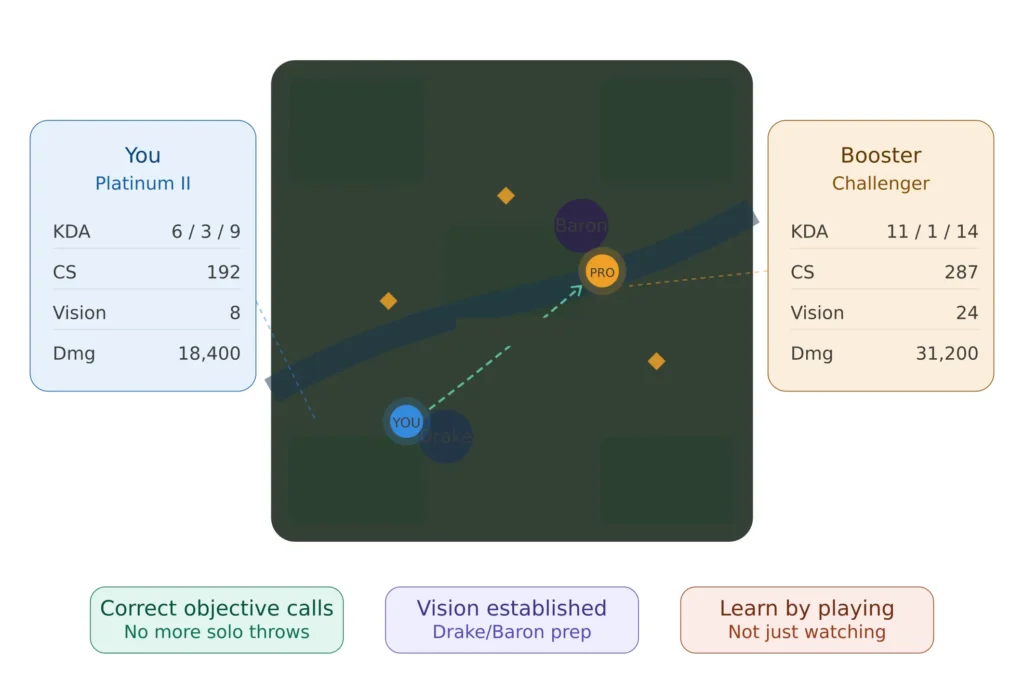
The experience feels different. You are still playing every game on your own account, but now you are doing it alongside someone who has already completed the climb many times before (and won’t mental-boom after giving up First Blood). For many players, the appeal is not just the rank gain. It is finally playing games where objectives are called correctly, vision is established before major fights, and teammates understand how to convert a lead into a win. Anyone who has spent enough time in Solo Queue has seen the same story play out: your team wins every lane, secures an early lead, takes a few towers, and then somehow throws the entire game around Baron twenty minutes later.
Some Things Only Make Sense in Real Games
League content is everywhere. You can watch Challenger streams, educational YouTube channels, professional VOD reviews, and coaching sessions. Many concepts still remain surprisingly difficult to apply in your own games. Take objective preparation as an example. Almost everyone knows the theory here: you need to control vision, clear the pixel brush, and set up the map before Dragon spawns. In practice, countless Emerald and Diamond players still arrive late, face check brushes without information, fight while out of position, and then wonder why every objective contest feels chaotic.
Playing alongside stronger players often exposes these mistakes much faster than watching another guide. Most Challenger players are not winning because they click faster. They are winning because they already know where they want to be on the map before everyone else does. By the time an objective spawns, they have already planned the next thirty seconds of the game. That difference is difficult to understand from a YouTube video. It becomes much easier when you experience it in real matches.
How Marketplace Platforms Changed Boosting
The boosting industry has changed significantly over the last few years. Instead of relying on anonymous websites, players increasingly use marketplace style platforms where they can compare providers, read reviews, and choose specialists for particular roles or champions. A jungle player looking for help can work with someone who primarily plays jungle, while an ADC main can find a partner who understands bot lane matchups and power spikes. This level of transparency was rare in the early days of boosting.
Platforms such as Boosting24 helped push the market in this direction by making the process more similar to a freelance marketplace. Players can compare options, communicate directly with experts, and choose someone who matches their goals. That approach feels very different from the old model where customers often had no idea who was actually playing on their account.
Coaching or Boosting?
The choice depends on what is actually holding you back. If you consistently struggle with lane management, objective control, or understanding win conditions, coaching is probably the better investment. A good coach can identify mistakes that might otherwise take months to discover on your own.
Not every player has that problem. Some already understand the game reasonably well. Their biggest challenge is finding enough time to play eighty or one hundred ranked matches before the split ends. In those situations, the issue is not knowledge, but time. A professional elo boost lol service becomes a practical option for players who simply cannot dedicate endless hours to the ranked grind.
Final Thoughts
League of Legends has always been a game of endurance as much as skill. As the player base gets older, free time becomes increasingly valuable. Most players do not quit League because they stop enjoying the game. They quit because the climb starts feeling like a second job. Anyone who has spent an entire weekend trying to recover LP after a losing streak knows exactly what that feels like.
For some players, these services are about improvement. For others, they are simply about saving time. Their popularity reflects something every long time League player already knows: utilizing a reliable elo boost lol platform is just a practical response to a broken system (where climbing ranked ultimately takes a lot more than just skill).

Jennifer R. Povey is a freelance game writer and editor specializing in narrative design, game content, and fiction editing. She crafts immersive stories and sharp dialogue that bring interactive worlds to life. She works directly with clients—no outsourcing, no referrals—ensuring quality and consistency in every project.