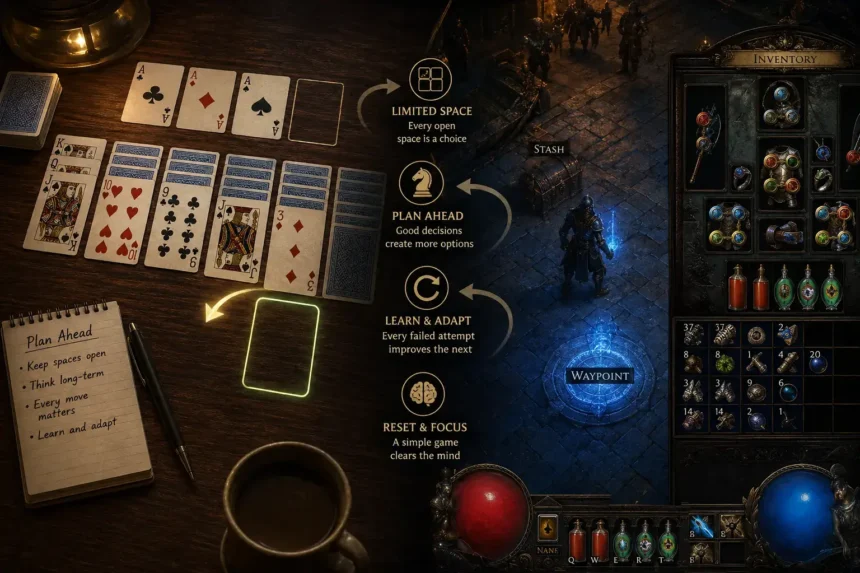
Path of Exile and solitaire appear to sit at opposite ends of gaming. One surrounds the player with builds, loot and interconnected systems, while the other begins with a familiar deck of cards. Yet both become interesting for the same reason: space is limited and every choice changes what can happen next. A quick game on PlaySolitaire makes this visible immediately. Moving one card may reveal an option, occupy a useful column or block a later sequence. Path of Exile asks players to make larger versions of the same decision whenever they manage inventory, resources and the direction of a build.
Every open space represents a choice
In solitaire, an empty column is not merely unused room. It is a strategic resource. Filling it too quickly can remove flexibility, while preserving it may allow a hidden card to become available later. The board teaches players to see space in terms of future actions rather than immediate convenience.
Path of Exile players recognise the feeling. Inventory slots, stash organisation and available sockets all shape what can be kept and what must be left behind. The specific systems are more complex, but the underlying question is familiar: does this choice create more useful options, or does it close them?
Planning beats frantic reaction
A new solitaire player often moves every visible card simply because the move is legal. Experience introduces restraint. It can be better to expose a different stack first, preserve a colour sequence or delay a move until its consequences are clearer. Progress depends on seeing relationships across the whole layout.
Complex action games reward the same habit at a different speed. A strong build is not a collection of individually appealing choices. Skills, equipment and passive decisions need to support one another. Reacting to every attractive item without a larger plan can create a character that has many interesting parts but no clear strength.
Failed attempts improve the next run
Not every solitaire deal can be solved from the decisions a player makes, and not every experimental build performs as expected. Failure becomes useful when it reveals the point at which flexibility disappeared. Perhaps an important card was covered too early. Perhaps too many resources were committed before the real weakness became visible.
Both games encourage another attempt with better information. The player does not need to repeat every action exactly. A new deal or new character creates room to test one adjustment at a time. This makes improvement feel practical rather than abstract.
A simple game can reset a complex session
Long sessions in a system rich game can produce decision fatigue. There are maps to evaluate, items to compare and several possible upgrades competing for attention. A short round of solitaire offers a different pace without abandoning strategic thought. The rules are contained, the board is visible and the next objective is clear.
That contrast can be useful between demanding activities. Solitaire keeps the mind engaged, but it reduces the number of systems that must be remembered at once. After a brief reset, returning to a more complex game may feel less cluttered.
Different systems reward the same habit
The most satisfying games give meaning to limitations. If every card could move anywhere, solitaire would lose its tension. If every item and skill could be used without tradeoffs, character planning would matter far less. Restrictions create identity because they require the player to choose what matters now and what should remain possible later.
This shared logic explains why a classic card game can still appeal to players who enjoy far more elaborate worlds. Solitaire reduces strategy to a compact layout, but it does not remove judgment. Path of Exile expands the number of variables, yet the best decisions still begin with attention, patience and respect for limited space.
Strafe is an ARPG content creator and gamer focused on Path of Exile (PoE) and Path of Exile 2 (PoE 2). His content comes from hands-on gameplay, exploring builds, bosses, mechanics, maps, and the many challenges that make the PoE experience so addictive.