
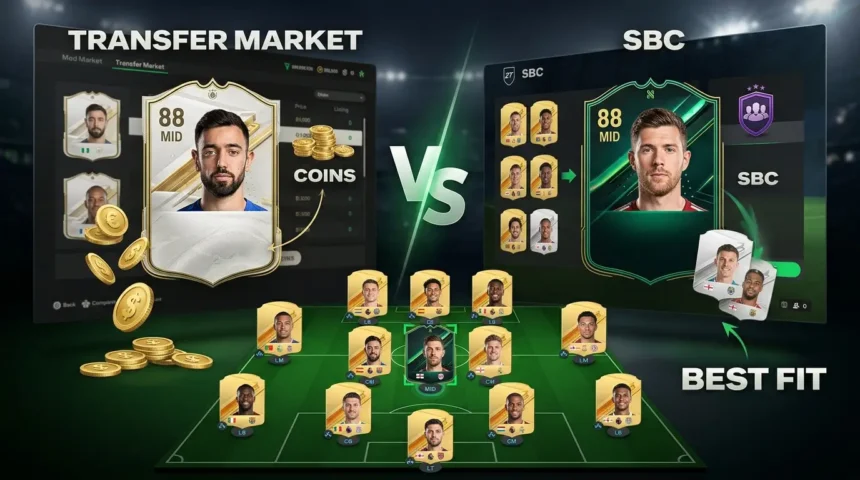
You need a new midfielder. One suitable card is available on the Transfer Market; another comes from a Squad Building Challenge. The market player costs more coins today, while the SBC looks inexpensive because much of the required material is already in your club.
Which is better? Usually, the market route suits a squad you are still testing. A player SBC makes more sense when its reward fills a clear role and you can comfortably give up the required items.
Players comparing FUT Coins offers should settle that choice first. A larger balance does not make an unsuitable upgrade worthwhile.
Platform-rules reminder: EA prohibits buying coins from third parties. Penalties can include coin removal, Transfer Market restrictions, or account bans. Seller assurances do not change those rules. The budgeting advice below concerns how to allocate your club’s resources, not how to bypass EA’s restrictions.
Define the job before comparing the cards
“I need a better midfielder” is too broad. Try: “I need someone who can receive under pressure, move the ball forward, and still cover the centre when possession changes.”
That description gives both candidates the same test.
Compare the exact card versions, eligible positions, relevant attributes, Player Roles, and PlayStyles. Then place each candidate into your intended team and inspect the chemistry consequences. A higher overall rating does not automatically solve the problem you identified.
Include any supporting changes. If one midfielder requires replacing another starter to fit your squad, that second purchase belongs in the upgrade plan.
Also ask whether the issue needs a signing at all. Losing the ball because you repeatedly force passes is different from lacking a player who can execute the passes your system needs.
Understand what you are exchanging in an FC 27 SBC
FC 27 includes both traditional Puzzle SBCs and Simplified, or Streamlined, SBCs. According to EA’s SBC guide, the latter use eligible items to build toward an Item Score target, rather than requiring a complete squad arrangement.
Eligible duplicates can contribute, and progress can be submitted across sessions. However, submitted items leave your club permanently. Partial progress is not a reversible reservation of those cards.
Check the specific eligibility rules and reward before choosing material. Do not assume every challenge uses the same minimum rating or that every reward is untradeable.
EA’s FC 27 launch notes explain that Item Score reflects overall rating, rarity, and Holographic status. A familiar “cheap fodder rating” from an older game is therefore not a complete solution.
The relevant question is which eligible combination completes this particular challenge at an acceptable cost to your club.
Keep two separate cost lists
The first list is coins you must spend now.
For the Transfer Market route, include the player purchase and necessary supporting changes. For the SBC route, include the missing eligible items you must acquire to finish—not merely the first submission you can afford.
The second list is useful resources you give up.
A tradeable item submitted to an SBC cannot also be sold. An untradeable item cannot generate sale proceeds, but might still be a starter, substitute, or material for a different challenge.
“Already owned” does not mean “worthless.” Equally, assigning a fictional market resale price to an untradeable card makes the comparison misleading.
Consider a hypothetical club with enough spare eligible items to cover most of a midfielder SBC. If those cards have no playing role and no competing planned use, the low additional coin spend is meaningful. If completion consumes your starting centre-back and your only reliable substitute, the same advertised completion cost describes a very different decision.
Buy flexibility when you are still experimenting
A tradeable market purchase gives you an exit option: you can try to sell the item if it does not suit your team. That flexibility is useful when you are changing formations or learning which player profiles work for you.
It does not guarantee a full refund. Sale proceeds can be lower than your purchase cost, and you must account for the applicable market deduction.
Our PoE Ninja guide’s discussion of pricing limitations highlights a distinction that also matters here: an asking price is not proof of a completed sale. Do not budget potential resale proceeds as though they are already in your balance.
For an untradeable SBC reward, evaluate the card as something you intend to keep using. Ask whether you would still want it if another appealing option appeared before your next planned upgrade.
Complete the whole plan before the first submission
The most dangerous SBC budget is “I can start it now and figure out the rest later.”
Before submitting, identify the reward, expiry, remaining requirements, and material you are willing to surrender. Protect starters and essential substitutes by reviewing the actual selection rather than trusting an automatic fill.
For an Item Score challenge, inspect each selected item’s contribution. Avoid consuming a card you want to keep merely because it reaches the target quickly.
If you already made partial progress, assess the remaining cost against the remaining benefit. Previous submissions do not make further spending automatically sensible.
If a Simplified SBC expires before you finish it, EA explains that the progress you submitted may qualify for a reduced untradeable reward. This is an expiry outcome, not a reward for every partial submission or the intended full-completion reward. Submitted Player Items are not returned.
What if neither route fits your balance?
Keep a reserve based on your next realistic need: a supporting signing, a replacement for a weak position, or another upgrade you have already planned. There is no universal percentage that every club must save.
Before deciding whether to Buy FIFA Coins to cover a shortfall, calculate the gap after accounting for your existing balance and realistic net proceeds from unwanted tradeable items. Compare that gap with a cheaper suitable upgrade and the rewards you can work toward through ordinary play. The aim is to establish whether more spending is necessary at all, not to make every attractive player fit your budget.
Skipping both options is a legitimate outcome. A card can be appealing without being the right use of your resources.
Use three questions to make the final call
- Fit: Does this exact card solve the identified problem without creating another?
- Cost: Can I cover the full additional spend and surrender the selected items without weakening the club elsewhere?
- Flexibility: Am I happy to commit, or do I still need the option to change direction?
Prefer the Transfer Market when uncertainty makes flexibility valuable. Prefer the SBC when the reward is a clear fit and the full exchange is acceptable. If neither passes all three checks, keep the resources.
The better upgrade is not necessarily the one with the smallest displayed cost. It is the one your squad can use and your club can afford to complete.

Jennifer R. Povey is a freelance game writer and editor specializing in narrative design, game content, and fiction editing. She crafts immersive stories and sharp dialogue that bring interactive worlds to life. She works directly with clients—no outsourcing, no referrals—ensuring quality and consistency in every project.