
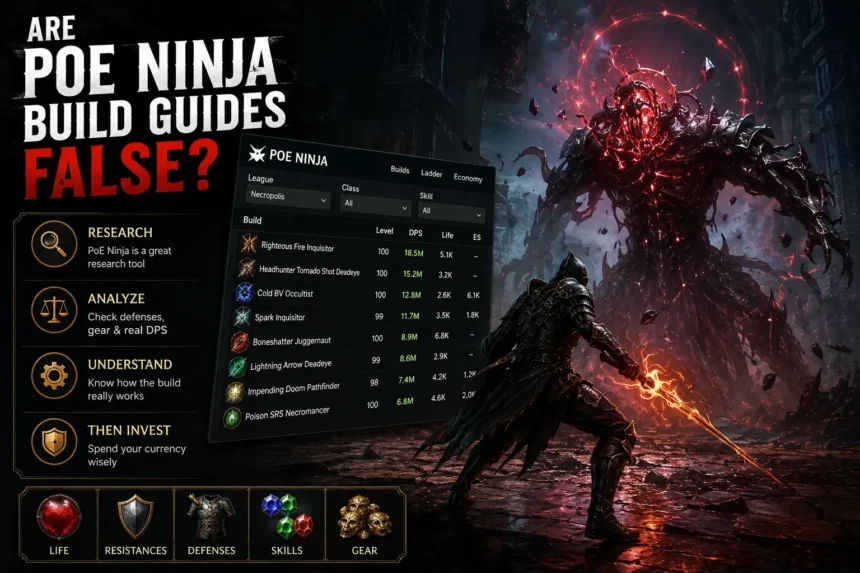
I’ve used PoE Ninja plenty of times over the years, and I can understand why newer players sometimes come away frustrated with it. You find a level 100 character with huge DPS, copy the gear and passive tree, spend a good amount of currency, and then wonder why your character keeps dying.
The problem usually isn’t that PoE Ninja is completely wrong. The problem is assuming every character listed there is a ready-to-copy build guide.
Why PoE Ninja Builds Can Be Misleading
PoE Ninja is excellent for looking at build trends and seeing what other players are playing. But the numbers don’t always tell you the full story.
For example, a character might be using:
- Extremely expensive endgame gear
- Multiple auras supported by group play
- A setup designed for a specific farming strategy
- Damage calculations that assume certain buffs or conditions
- Very low defenses in exchange for maximum DPS
That character might work perfectly for its owner but perform terribly when copied without understanding the setup.
Don’t Judge a Build by DPS Alone
This is probably the biggest mistake I see.
When I look at a PoE Ninja build, DPS is only one part of the picture. A character with enormous damage but poor survivability isn’t necessarily better than a balanced build with lower damage.
Some calculations can also make DPS look better than what you’ll realistically achieve during gameplay. Certain mechanics depend on maintaining buffs, stacks or conditions that aren’t always practical in difficult content.
So I always ask myself:
Can this character actually survive while dealing that damage?
How I Check a PoE Ninja Build
Before spending currency, I recommend importing the character into Path of Building and doing a quick sanity check.
I usually look at:
| What I check | Why it matters |
|---|---|
| Life / Energy Shield | Basic survivability |
| Resistances | Makes sure the character isn’t relying on unrealistic numbers |
| Defensive layers | Shows how the build actually survives |
| Gems and auras | Helps identify unrealistic configurations |
| Gear cost | Determines whether the build is affordable |
| Damage configuration | Shows where the advertised DPS comes from |
This takes only a few minutes and can save you from wasting a lot of currency.
Look at SSF and Hardcore Characters
One trick I personally like is checking SSF or Hardcore SSF characters when researching a build.
These characters can’t rely on an aurabot or easy access to trade gear in the same way trade-league characters can. Hardcore characters also have much more reason to prioritize defenses.
That doesn’t mean every HC or SSF build is automatically better. But it can give you a more realistic idea of what makes a character durable.
PoE Ninja Is a Tool, Not a Build Guide
I wouldn’t completely dismiss PoE Ninja. I still use it when I want to research skills, ascendancies, item choices and current build trends.
I just don’t blindly copy the first level 100 character I find.
For me, the best approach is simple:
- Use PoE Ninja to find interesting builds.
- Import the character into Path of Building.
- Check the defenses and configuration.
- Understand the expensive or unusual items.
- Make sure the build actually fits the content you want to run.
If a build looks too good to be true, I investigate it before spending my currency.
My Take
So, are PoE Ninja builds false?
Not necessarily. But they can definitely be misleading if you don’t understand what you’re looking at.
PoE Ninja gives you data from real characters, but it doesn’t promise that every character is a practical build guide for the average player.
I use it as a source of ideas and statistics, then do my own checking before committing to a build. That’s a much safer way to use the site, especially if you’re still learning how Path of Exile’s mechanics work.

Luke Yapz is a passionate ARPG player and gaming content creator focused on Path of Exile (PoE), Path of Exile 2 (PoE 2), and poe.ninja. He enjoys digging into builds, game mechanics, economy trends, and player data to help the PoE community make smarter decisions.
Through practical guides, insights, and hands-on experience, Luke aims to make complex PoE systems easier to understand—whether you’re improving a build, keeping up with the economy, or looking for useful data to gain an edge.